Mastering KDP with a Premium Glucose Log Book Interior: A Complete Guide for Publishers
The landscape of self-publishing has evolved significantly over the last decade, shifting from a niche hobby to a robust business model for entrepreneurs worldwide. Among the most enduring and profitable categories within Amazon’s Kindle Direct Publishing (KDP) ecosystem is the low-content and medium-content book market. Specifically, health-related trackers have seen a surge in demand as individuals take proactive steps toward managing their well-being. For publishers looking to enter or expand within this niche, a professionally designed Glucose Log Book KDP Interior represents more than just a digital file; it is a ready-to-print asset that solves a specific problem for end-users while streamlining the creation process for the seller.
Understanding the nuances of these interiors is critical for success. It is not merely about placing lines on a page; it is about creating a functional tool that adheres to strict printing standards and offers genuine value. This guide explores the significance, technical specifications, and strategic application of high-quality glucose log book interiors, ensuring your publishing journey is both compliant and commercially viable.
The Purpose and Significance of Health Tracking Journals
To sell a product effectively, one must first understand the user's intent. A glucose log book serves a vital medical and lifestyle purpose. For individuals managing diabetes, pre-diabetes, or gestational diabetes, tracking blood sugar levels is not optional—it is essential for survival and long-term health. While smartphone apps have gained popularity, there remains a substantial demographic that prefers physical logging.
Why does the physical format persist in a digital age? Several factors contribute to this trend:
- Tactile Accountability: The act of writing reinforces memory and commitment. For many patients, physically recording a reading creates a stronger psychological connection to their health data than tapping a screen.
- Battery Independence: Medical tracking cannot rely on battery life or software updates. A physical book is always accessible, regardless of technology failures.
- Clinical Utility: Endocrinologists and primary care physicians often prefer reviewing a handwritten log during appointments. It provides an unalterable timeline of readings, medication dosages, and dietary notes that can be scanned quickly without navigating through app menus.
- Digital Detox: Many users actively seek to reduce screen time, especially before bed or immediately upon waking when glucose testing is frequent.
By providing a Glucose Log Book KDP Interior, you are not selling blank paper; you are selling organization, peace of mind, and a bridge between patient and provider. Recognizing this distinction helps in crafting better marketing copy and selecting interiors that truly serve the community.
Technical Excellence: Understanding KDP Specifications
One of the most common pitfalls for new KDP publishers is uploading files that fail quality checks or result in poor customer reviews due to formatting errors. A premium interior package eliminates this guesswork. When evaluating or utilizing a Glucose Log Book KDP Interior perfect for your low or no content business, specific technical parameters must be met to ensure the final product looks professional.
Trim Size and Bleed Settings
The industry standard for portable health journals is the 6 x 9 inch trim size. This dimension strikes the ideal balance between portability and usability. It is small enough to fit in a purse, glove compartment, or large pocket, yet large enough to accommodate legible handwriting and comprehensive data columns. Crucially, these interiors are formatted with no bleed.
In printing terminology, "bleed" refers to ink extending beyond the edge of the page. For log books, no bleed is typically preferred because all content (lines, headers, tables) stays safely within the margins. This ensures that no critical tracking fields are accidentally trimmed off during the binding process. A properly formatted 6x9 no-bleed PDF accounts for the gutter margin—the inner space where the book binds—ensuring that writing space remains consistent from the first page to the last.
Page Count and Structure
A 120-page count is strategically significant. In the world of KDP, spine text is only available for books with at least 79 pages. A 120-page book allows for a professional spine design, which dramatically increases perceived value and shelf appeal. Furthermore, 120 pages provide approximately three to four months of daily tracking, making it a practical purchase for quarterly health reviews.
The Value of Variants: Meeting Diverse User Needs
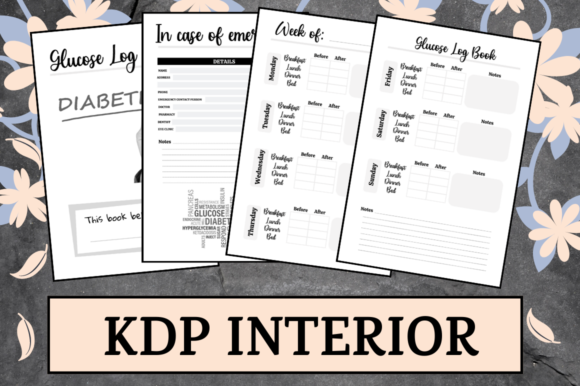
A common misunderstanding in the low-content space is the assumption that one size fits all. However, diabetes management varies greatly depending on the type of diabetes, treatment plan, and personal preference. This is why a high-quality resource includes 5 different variants of PDF files. Offering variety protects your business against market saturation and allows you to target specific sub-niches.
Consider how different variants serve different segments:
- Standard Daily Tracker: Focuses on date, time, fasting/post-meal readings, and insulin units. Ideal for Type 2 diabetics on stable regimens.
- Detailed Food & Carb Log: Includes extensive space for meal descriptions and carbohydrate counting. Essential for those using insulin-to-carb ratios.
- Weekly Overview Format: Displays a full week on two pages, allowing users to spot trends and patterns at a glance rather than flipping through daily entries.
- Gestational Diabetes Edition: Tailored specifically for pregnancy, often including kick counts or specific testing windows required by OB-GYNs.
- Pediatric/Caregiver Version: Designed with larger fonts or simplified layouts for children or elderly users with dexterity challenges.
When an interior package is described as ready for printing and formatted and tested for KDP, it means these variants have already undergone rigorous validation. You avoid the costly mistake of purchasing a generic template only to discover it lacks the specific fields your target audience requires.
Streamlining Your Low-Content Business Model
For entrepreneurs, time is the most valuable currency. Creating a medically accurate, aesthetically pleasing, and technically compliant log book from scratch can take dozens of hours. Between researching necessary data fields, designing layouts in InDesign or Canva, calculating gutter margins, and running test prints, the barrier to entry can be high.
Utilizing a pre-made, ready to upload interior transforms this workflow. Instead of acting as a designer, you can focus on being a publisher and marketer. This shift is crucial for scaling a low-content business. The efficiency gained allows you to:
- Test Multiple Niches: With five variants available, you can publish multiple versions to see which resonates best with buyers without additional design labor.
- Focus on Cover Design: In KDP, the cover sells the book. By outsourcing the interior complexity, you can dedicate more creative energy to designing covers that stand out in search results.
- Ensure Consistency: Professional interiors maintain uniform margins and font sizing, establishing brand quality across your catalog.
Educational Responsibility and E-E-A-T Principles
Publishing in the health category carries a responsibility to adhere to Experience, Expertise, Authoritativeness, and Trustworthiness (E-E-A-T). Even though you are providing a tool rather than medical advice, the quality of that tool reflects your expertise.
A tested interior demonstrates experience with KDP’s platform requirements. It shows expertise in understanding what diabetic patients actually need to track. It builds authority by presenting a polished, error-free product. Most importantly, it establishes trust. A user managing a chronic condition needs to trust that their log book will not fall apart, that the margins won’t swallow their data, and that the layout makes sense.
Furthermore, when listing these books, avoid making medical claims. Position the book as an organizational aid, not a treatment device. Use descriptive language that highlights the utility of the Glucose Log Book KDP Interior without overstepping into diagnostic territory. This approach aligns with helpful content guidelines and ensures long-term account safety.
Practical Application and Future Proofing
Integrating these interiors into your business is straightforward. Because the files are standardized PDFs, they are compatible with all major publishing platforms, not just Amazon. This flexibility allows for diversification across Etsy, Lulu, or direct sales channels.
As you build your portfolio, consider how these log books fit into a broader ecosystem. They pair naturally with diabetic cookbooks, exercise journals, or wellness planners. By understanding the foundational elements of a quality interior—correct trim size, appropriate page count, lack of bleed, and user-centric variants—you position yourself not just as a seller of notebooks, but as a provider of health management solutions.
Ultimately, the success of a low-content business relies on the intersection of technical precision and human empathy. A Glucose Log Book KDP Interior that is formatted, tested, and varied bridges that gap perfectly. It respects the platform’s rules while honoring the user’s needs, creating a sustainable product that stands the test of time in an ever-evolving marketplace.