Mastering KDP with a Premium Meeting Notebook Interior: A Complete Guide for Low-Content Publishers
The landscape of self-publishing has evolved dramatically over the last decade, transforming Amazon Kindle Direct Publishing (KDP) into a viable ecosystem for entrepreneurs, designers, and passive income seekers. While fiction and non-fiction books dominate the headlines, the low-content and medium-content book market remains a powerful entry point for new publishers. Among these niches, the professional meeting notebook stands out as a perennial bestseller. However, success in this category is no longer about uploading a generic lined journal; it requires strategic design, technical precision, and an understanding of user needs. This is where a specialized Meeting Notebook KDP Interior becomes the cornerstone of a profitable publishing business.
For publishers looking to streamline their workflow while maintaining high quality, utilizing a pre-formatted, tested interior is essential. Specifically, interiors designed with a trim size of 8″ x 10″, featuring 120 pages and no bleed settings, offer the perfect balance of usability and printing economy. Understanding why these specifications matter—and how to leverage the three common PDF variants included in professional templates—can significantly reduce rejection rates and increase customer satisfaction.
The Strategic Value of Specialized Meeting Notebooks
To understand why a dedicated meeting notebook interior performs better than a standard journal, we must first look at the end-user's intent. In a modern business environment, professionals are inundated with digital noise. Despite the prevalence of tools like Notion, Trello, and Microsoft Teams, there is a persistent, growing demand for analog organization. Cognitive research suggests that handwriting notes improves retention and conceptual understanding better than typing. A meeting notebook bridges this gap by providing a structured physical space for digital-age problems.
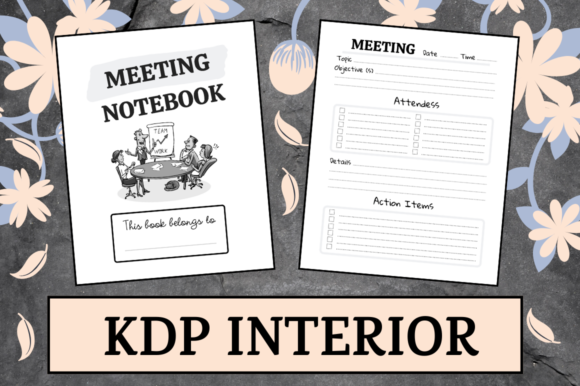
A generic lined notebook forces the user to create their own structure every time they open it. In contrast, a purpose-built meeting notebook provides immediate cognitive scaffolding. It prompts the user to record the date, attendees, agenda items, action points, and follow-up tasks without having to draw lines or headers manually. For the KDP publisher, this distinction is critical. You are not selling paper; you are selling productivity and organization. When your interior solves a specific problem, your book transitions from a commodity to a tool, which justifies a higher price point and fosters brand loyalty.
Understanding the 8″ x 10″ Trim Size Advantage
One of the most crucial decisions in low-content publishing is selecting the right trim size. While 6″ x 9″ is the industry standard for trade paperbacks, the 8″ x 10″ trim size is often superior for meeting notebooks and business planners. This dimension offers several distinct advantages that directly impact both the user experience and your profit margins.
- Writing Real Estate: Business meetings often involve complex diagrams, mind maps, or extensive action lists. The extra width of an 8″ x 10″ page accommodates this content without feeling cramped, making it more practical for corporate environments.
- Perceived Value: Larger formats are psychologically associated with workbooks, textbooks, and premium stationery. Customers browsing Amazon often perceive 8″ x 10″ books as more substantial and valuable than smaller journals, even if the page count is identical.
- Printing Cost Efficiency: KDP printing costs are calculated based on page count and ink type, but the trim size affects the perceived value-to-cost ratio. An 8″ x 10″ book with 120 pages feels like a significant volume, allowing for competitive pricing while maintaining healthy royalties.
Technical Precision: No Bleed and Page Count Optimization
Technical errors are the primary reason KDP manuscripts are rejected or receive negative reviews. Using a professionally formatted interior that is "ready for printing" eliminates the guesswork regarding margins, gutters, and safe zones. The specification of no bleed is particularly important for beginners and experienced publishers alike.
In printing terminology, "bleed" refers to artwork that extends beyond the edge of the page, requiring the printer to trim the paper to achieve an edge-to-edge look. While aesthetically pleasing for art books, bleed adds complexity and cost to low-content books. A no-bleed interior keeps all content within a defined safe zone. This ensures that text, checkboxes, and header lines never get cut off during the trimming process. Furthermore, no-bleed files are generally easier to format and less prone to alignment shifts during the automated KDP review process.
The 120-page count is another strategic sweet spot. KDP has minimum page requirements for certain distribution channels and spine text eligibility. Books under roughly 100 pages often cannot have text printed on the spine, which makes them difficult to identify on a bookshelf or in a store display. At 120 pages, your meeting notebook qualifies for spine text, enhancing its professional appearance and discoverability. Additionally, 120 pages provide enough utility for several months of regular meetings without making the book too heavy or expensive to ship.
Leveraging Multiple PDF Variants for Business Growth
A high-quality Meeting Notebook KDP Interior package typically includes 3 different variants of PDF files. Understanding how to use these variations is key to scaling a low-content business. Rather than viewing these as redundant files, savvy publishers treat them as opportunities for product differentiation and A/B testing.
- The Standard Professional Variant: This usually features clean, minimalist lines with ample white space. It targets corporate executives, project managers, and administrative assistants who prefer a distraction-free layout. This should be your baseline product.
- The Detailed/Structured Variant: This version may include additional prompts such as "Key Decisions," "Parking Lot," or specific sections for virtual meeting links. This variant appeals to agile teams, scrum masters, and users who need rigorous documentation structures.
- The Creative/Hybrid Variant: Often incorporating dot grids alongside lined sections or larger blank spaces for sketching, this variant targets creative professionals, designers, and marketers who attend meetings but also need space for visual ideation.
By offering these three distinct interiors, you can target multiple sub-niches within the broader "meeting notebook" keyword cluster. You might publish one version titled "Executive Meeting Journal" and another as "Agile Sprint Notebook," using the same base template but different interiors to capture diverse search intents. This approach maximizes the return on investment for a single design asset.
Best Practices for Uploading and Marketing
Having a formatted and tested interior is only half the battle. To succeed, you must integrate this asset into a holistic publishing strategy. Because the interior is already optimized for 8″ x 10″ with no bleed, your primary focus can shift to cover design and metadata optimization.
Your cover must clearly communicate the interior's utility. Since customers cannot physically flip through the book, use the back cover or A+ Content to showcase screenshots of the interior pages. Highlight the specific features that make your notebook unique, such as the action-tracking sections or the 8″ x 10″ size. Transparency builds trust; when customers know exactly what they are buying, return rates decrease and positive reviews increase.
Furthermore, ensure your keyword strategy aligns with the specific variant you are uploading. If you are using the structured variant, target keywords like "project management notebook," "action tracker," or "corporate minute taker." If you are using the hybrid variant, pivot toward "creative planning journal" or "visual meeting notes." Semantic relevance between your interior content and your metadata signals to Amazon’s algorithm that your book is a helpful resource for specific queries, adhering to modern E-E-A-T (Experience, Expertise, Authoritativeness, and Trustworthiness) principles.
Common Misconceptions About Low-Content Interiors
It is vital to address a common misunderstanding in the KDP community: the belief that "low content" means "low effort." New publishers often assume that any PDF will sell if the cover is attractive. However, the market has matured. Buyers now scrutinize Look Inside previews and read reviews specifically mentioning interior quality. A poorly formatted interior with inconsistent margins or useless layouts will lead to bad reviews that permanently damage your book's ranking.
Using a pre-tested, 120-page, 8″ x 10″ interior is not a shortcut; it is a quality assurance measure. It demonstrates respect for the customer's time and money. It acknowledges that even in a low-content product, the user experience is paramount. By starting with a professional foundation, you free up your creative energy to focus on branding, niche research, and building a sustainable publishing portfolio rather than troubleshooting formatting errors.
Conclusion: Building a Sustainable Publishing Asset
The Meeting Notebook KDP Interior represents more than just a digital file; it is a foundational asset for a scalable publishing business. By adhering to technical best practices like the 8″ x 10″ trim size, no-bleed formatting, and optimal page counts, publishers can create products that meet professional standards and customer expectations. The inclusion of three PDF variants further empowers creators to test markets, serve diverse audiences, and maximize the potential of a single design concept.
In an era where digital fatigue is real, the demand for thoughtful, well-designed analog tools continues to grow. Whether you are a seasoned publisher looking to expand your catalog or a beginner seeking a reliable entry point, investing in high-quality, ready-to-upload interiors is a strategic move. It allows you to bypass technical hurdles and focus on what truly matters: connecting with readers and providing genuine value in their daily professional lives. With the right interior foundation, your low-content business can achieve long-term stability and success in the competitive world of KDP.